Barbara Cooper has been volunteering at the administrative office of Asheville Area Habitat for Humanity since January 2016. We recently sat down with Barb to learn about her volunteer experience.
Habitat: Why did you decide to volunteer for Asheville Area Habitat?
Barb: Habitat’s mission connected with me on a personal level, and I wanted to give back the hope and help I was thankful enough to receive since I’ve been in WNC. Asheville has become a new start – a safe place – for my daughter and I, and I wanted to be a part of the journey of making that happen for others.
Habitat: What does a typical volunteer shift look like for you?
Barb: I volunteer every Thursday from 11am to 3pm at the front desk in the administrative building. The day always flies by so quickly. I am answering phones and directing inquiries, filing paperwork, inputting information into spreadsheets, and sending out thank you postcards to donors. Sometimes I help out on special projects staff members asked me to do… and always with a smile on my face!
Habitat: How do you spend your time when you’re not volunteering with Asheville Area Habitat?
Barb: I am enjoying my retirement. For the most part, I spend free time with my family because they are the most important people to me. I’m also in the process of training for a 5K race in September. Please wish me luck, I’ll need it!
Habitat: Do you have a specific story from volunteering that stands out to you?
Barb: One particular Thursday, there was a big group of people meeting in the large conference room. Needless to say, there was a lot of traffic in the ladies and men’s restrooms. Evidently, one of the men’s bathrooms got backed up, and one of the members from the meeting came to me and reported the problem. I asked him if there was a plunger and he said he didn’t see one. So I took it upon myself to go in and rectify the situation. When the men’s bathroom was fixed, I went back to my desk to do more work for an hour. Then a woman came to me and told me the ladies restroom had a similar issue. I just chuckled to myself and marched back in to the bathroom to resolve that problem. Once that was done, I went back to my desk and told my supervisor about what had transpired. She laughed, thanked me for what I did, and said “It was not in your job description. You went over and beyond the call of duty.” As you can imagine, that’s one memory I will never forget!
Habitat: How do you see your volunteering as a part of Habitat’s mission to “bring people together to build homes, communities, and hope”?
Barb: Habitat’s mission is extraordinary, and I have the privilege of being a part of it. My job as a volunteer in the administration building is to be open, welcoming, receptive, and kind. I connect with people, as well as direct inquiries and provide educational material if they ask for it. I might be the very first person they see on their journey to a new home and a new life. If I can give them hope and put a smile on their face, I believe I will continue to play a positive role in Habitat’s mission.
Habitat: How has volunteering at Habitat impacted you?
Barb: Habitat has given me an opportunity to grow as a person by giving back to the community. I truly look forward to every Thursday because I know the work I do makes a positive difference. Also, I’m very thankful I found Habitat because it’s been an amazing platform that has helped me develop and utilize my clerical skills.
Habitat: What would you say to someone who is considering volunteering at Asheville Habitat?
Barb: I would say go for it! My experience has been nothing but positive and I imagine the same can be said for anyone else that begins volunteering at Asheville Habitat.
Today, we’re thanking Barb for her commitment to Asheville Area Habitat and her service to everyone who enters Habitat’s doors in the pursuit of decent and affordable housing.
Interested in volunteering with us? Click here to learn more or sign up.
https://www.ashevillehabitat.org/wp-content/uploads/2018/12/blog-Barb-Cooper.jpg350800Asheville Habitathttps://www.ashevillehabitat.org/wp-content/uploads/2022/11/AAHH-logo_black_with-counties-tag-300x150.jpgAsheville Habitat2017-04-24 00:00:002017-04-24 00:00:00A Friendly Face at the Front Desk
With volunteers central to our business model, we are recognizing milestones and thanking volunteers with small gifts and mid-day meals during National Volunteer Appreciation Week Habitat (April 23-29).
Whether you’re swinging a hammer at the construction site, fixing a floor at a home repair project, accepting donations at the ReStore, answering the phone in the office, or serving on a committee, each volunteer action directly impacts Habitat’s ability to serve more families in need of a decent and affordable place to live. Last year, 1,800 volunteers contributed 65,000 hours of service – at a value of more than $1.5 million!* Another way to look at it: the hours contributed by volunteers equates to having an additional 30 full-time staff members!
Every hand makes a difference and Habitat is grateful for the commitment of all volunteers, whether they helped one time or once a week, for the first time or for many years. Speaking of longevity, a number of our core volunteers (those who make a weekly or bi-weekly commitment) reached noteworthy service milestones in 2016.
Ray Ducharme and Bob Laveck (Construction) and Phil Casey, Bill Crownover and Alan Williams (ReStore), met the 15 year service mark.
Husband and wife duo Ken and Carol Deal reached their 20 year anniversary of volunteering together on the construction site.
ReStore volunteers Helen Andrews and Bruce Tettemer have been volunteering in the ReStore for 20 years.
Shirley Studwell (ReStore) celebrated 25 years of service with Habitat!
Some fun facts about Asheville Habitat’s volunteer program:
In 2016, through programs such as Global Village, Thrivent Builds Worldwide, and Collegiate Challenge, as well as the signature “Before the Jam, Lend a Hand” volunteer event, Asheville Area Habitat hosted volunteers from 28 different U.S. states and 3 countries.
It takes 1,650 hours of volunteer labor to build one Habitat house.
Habitat utilizes about 140 volunteers in the ReStore each week.
Core volunteers (those who volunteer on a weekly or bi-weekly basis) contributed 43,038 of the 65,000 hours of service!
Thanks to our volunteers (and donors, sponsors and ReStore supporters), Asheville Habitat built 14 new houses and repair 43 existing homes last year, helping to address our region’s affordable housing crisis and providing opportunities for families to build better futures.
If you’re interested in volunteering with us, please click here to learn more and sign up.
https://www.ashevillehabitat.org/wp-content/uploads/2018/12/blog-NVAW2017-1.jpg350800Asheville Habitathttps://www.ashevillehabitat.org/wp-content/uploads/2022/11/AAHH-logo_black_with-counties-tag-300x150.jpgAsheville Habitat2017-04-18 00:00:002017-04-18 00:00:00Every hand makes a difference
Here at the ReStore, we always try to showcase a diverse selection of unique and rare items in our bi-weekly Silent Auction, and this week we’d like mention a particular artist who donated generously to the current auction selection.
We are grateful to Pat Perkerson for donating a large amount of her personal artwork. Pieces range from paintings and collages to sculptures and pottery. These items are currently open to bidding, and this Silent Auction ends Wednesday, April 19th at 2 pm.
About the Artist:
Pat was born in what is now Zimbabwe, and has lived in England, Australia, and the Middle East. She now resides permanently in Asheville, but her work often reflects the influence of her travels. She attended art school in Australia, and holds a B.A. in Theatre Arts from California State University, Chico. She has also worked in the fields of archaeological illustration and education.
Her work includes both two-dimensional pieces such as paintings, and three-dimensional ones such as sculptures and lifelike figures. She also creates porcelain dishes by hand which are painted and then protected with a food-safe glaze.
Pat’s work has sold internationally, but it is represented primarily at the Miya Gallery in Weaverville, N.C. and the Artist’s Coop in Laurens, S.C.
We couldn’t be more grateful for Pat’s generous donation of art for our auction!
If you have items that you’d like to donate, whether it’s your artwork or another kind of unique treasure, feel free to contact the ReStore at 828.254.6706. Proceeds from our Silent Auction, like all other ReStore proceeds, help fund Habitat’s construction of affordable housing in Buncombe County.
https://www.ashevillehabitat.org/wp-content/uploads/2018/12/blog-artist-Pat-Perkenson.jpg350800Asheville Habitathttps://www.ashevillehabitat.org/wp-content/uploads/2022/11/AAHH-logo_black_with-counties-tag-300x150.jpgAsheville Habitat2017-04-14 00:00:002017-04-14 00:00:00Local Artist Pat Perkerson Donates to the ReStore Silent Auction
Stuck. In an unsafe home. Without resources to make simple things work, like a toilet, or to hire an electrician to repair faulty electrical outlets. After twenty seven years of wear and tear, and without the skills or financial resources to make necessary repairs, this is the situation in which former seamstress Geneva was living. It is not how her story of home began, nor is it where she expected it to lead. But sometimes you can’t anticipate what life has in store.
Mold permeated her grandson’s playroom, dangerous makeshift electrical work dangled by a cord, and there was no functional toilet. For years she lived with her situation, believing there was no other option. But taking in her six-year-old grandson Kaleel motivated her to seek help. That’s when she discovered Asheville Area Habitat for Humanity’s Home Repair program.
Volunteers help repair the playroom.
After her application was approved, our Home Repair team got to work, addressing the playroom first—a moldy converted garage. To remediate the moisture-induced mold problem, our team addressed drainage issues to divert water away from the house, pulled up the carpets, and removed and replaced the water-damaged sheetrock and framing. They installed new wall paneling and a new window and door. Growing Kaleel now enjoys a mold-free playroom. During the short time since the repairs were made, his asthma has improved!
Our crew also replaced one toilet and repaired another so that the family now has two working toilets. Several lights in this West Asheville house were not working and required improvements to the electrical system. The unsafe extension cords running throughout the house have been replaced and now light illuminates every room, safely.
Safety. Stability. Good health. It all starts at home. For nearly 35 years, Asheville Area Habitat has provided affordable homeownership opportunities to individuals and families through our new home program. But, for many people, the most affordable home is the one they already own. For the past six years, our Home Repair program has improved safety and accessibility for existing homeowners and their families. We’ve completed nearly 200 projects, and the majority of our Home Repair clients are elderly or disabled—some of the most vulnerable members of our community.
We repair and replace leaking roofs, update electrical and heating/cooling systems, add ramps and grab bars, and much more. Homeowners like Geneva pay only a fraction of the market cost of repairs, thanks to their sweat equity, our volunteers and affordable financing through Habitat.
Everyone deserves a decent place to live, and everyone can do something today to help make that possible for another family.
Geneva’s is just one of many stories of need in our community. Your donation can build a roll-in shower for a disabled vet who couldn’t bathe in his old claw foot tub. Or, it can install a new furnace for an elderly woman who has weathered the winters for years with dangerous kerosene heaters. These are real-life stories from Home Repair clients.
Your donation can change lives. Please make a gift today to help more families like Geneva’s have a safe place to live.
https://www.ashevillehabitat.org/wp-content/uploads/2018/12/SpringMailer2017_BlogImage-1.jpg350800Asheville Habitathttps://www.ashevillehabitat.org/wp-content/uploads/2022/11/AAHH-logo_black_with-counties-tag-300x150.jpgAsheville Habitat2017-04-13 00:00:002017-04-13 00:00:00More than new homes: Habitat’s Home Repair is changing lives.
The nine year old girl, center of her mother’s world, is too young to fully comprehend what her new Habitat home means to her mom and to their family. But she sure is excited to decorate her room and play with friends in her new neighborhood!
Elizabeth, the young girl’s mom, credits her daughter for inspiring her to better her future, and her father for encouraging her in the right direction. With motivation and support, she enrolled at AB-Tech, become a CNA, and secured a good job with a local alcohol and drug treatment center. Her next goal was straightening out her credit and becoming a homeowner. Mission accomplished, as she just signed her mortgage documents and proudly accepted the keys to her new Habitat home!
“One day she will realize how strong she made her momma,” said Elizabeth while proudly showing photos of her daughter and son, and waiting to sign her closing documents.
“I’ve had to make some very difficult decisions in the last six or seven years. If I stayed with her dad, I was staying in an abusive situation. But if I left that would mean my daughter would grow up without a father.”
Ultimately, Elizabeth chose the latter and is overwhelmed by everything she has accomplished for herself and her family — by herself. She was overcome with emotion as she looked at the key in her hand and thought back to a time of hopelessness. Proud of her perseverance and excited about what the future holds Elizabeth headed to her new home where her friends and her father were waiting to help her unload a U-Haul truck and unpack a fresh start.
If you’d like to learn more about Habitat’s affordable homeownership program, click here.
Every Tuesday, Susie Emerick arrives at the ReStore and begins organizing and preparing her work space. Susie works in the linens area of the store, a department that receives, cleans, and prices various fabrics that are available for purchase. These tasks aren’t for everyone, but Susie enjoys volunteering her time in this capacity.
Susie’s days of giving back to her community through volunteerism began more than 30 years ago. Before moving to Asheville more than a decade ago, Susie lived in Baltimore for 30 years. She volunteered with various organizations there, including a hospital. “I used to volunteer at the Children’s Hospital in Baltimore, which was very important,” Susie explained. “We usually received babies that had had surgeries or other procedures, and they were with us for a while before going home.”
Her volunteering with Habitat for Humanity began in Brunswick County (NC) before starting with Asheville Area Habitat more than 12 years ago. She and her husband volunteer on house builds occasionally, but most of her work with Habitat has been with the ReStore.
“When I first called to volunteer (in Asheville), this was the only department that needed help,” Susie said. “This is good because cashiers and other volunteers often need to stay all day and get here early, but I don’t have to. I can be kind of behind the scenes, which I like.”
The ReStore utilizes the help of 140 volunteers every week. Many are like Susie – rarely seen by customers because they are busy in the backrooms. But their work as just as important as the work done by volunteers on the showroom floor. Susie describes a normal day of volunteering in the linens area, and the importance of behind-the-scenes work at the ReStore. “We clean the items, organize them, and hang them up. After that, we determine what sizes things are. Customers want to know that information, and it’s hard to just judge what size sheets or other linens are. They need to be measured.”
“My favorite part of working here is that it keeps me busy, but it’s also relaxed. I’ve volunteered in many places in the past, and I like the pace here,” said Susie. “It’s always something different and it’s always changing. It’s never boring.”
Susie also volunteers with Animal Haven, a local organization that receives abused or neglected farm animals and domestic animals such as cats and dogs, and provides them shelter, food, and rehabilitation. They also work with other organizations such as Meals on Wheels and New Leash on Life to provide support for low-income households that have pets. “I like the hands-on work at Animal Haven,” Susie explained. “I clean the habitats and feed the animals, and recently we did a metal run, where we do a large recycling project with aluminum.”
So on this Thank You Thursday, we thank Susie for her service with the Asheville Habitat ReStore and other organizations that need hard working and passionate volunteers to help them reach their goals. She is committed to making a difference in her community, and we thank her for putting in the time and the energy to do so.
If you’re interested in volunteering with Asheville Habitat, please click here to learn more.
By Sammie Smith, Hands and Feet of Asheville Intern
Every March, our construction site fills up with excited college students participating in their Alternative Spring Break. Collegiate Challenge – or as we affectionately call it, March Madness – brings students from schools all over the country to Asheville for a week of volunteering. This year, we hosted students from Southern Illinois University Edwardsville, Lesley University (Massachusetts) and Ramapo College (New Jersey). One of the highlights of these service trips is the Wednesday night dinner with a future Habitat homeowner.
The most recent dinner included volunteers from both Leslie and Ramapo. In addition to enjoying fellowship and a delicious meal (thanks to a Thrivent grant), the students reflected on the work they’ve done at the construction site and how it has impacted them. Kit, from Lesley University spoke about how amazing the construction supervisors are and how “they take the time to carefully teach us how to complete the tasks on the jobsite”. Ramapo student Carlie noted, “It was rewarding to see the progression throughout the day from just dirt and rocks to a clean, insulated crawl space.” She went on to talk about how important stable housing is for kids to excel in school. Another Ramapo student reflected on the comradery among future homeowners stating, “I’ve been amazed by the sense of community…Homeowners working on each other’s houses even before they move in. Every step is awesome!” After a few days of working on the construction site and in the ReStore, Shannon, from Lesley University shared “the more I learn about Habitat, the more I fall in love with the organization!”
Jeff Paul, Habitat’s Homeowner Counselor, explained to the students the comprehensive process that Habitat homeowners go through: from initial application, through sweat equity hours and homeownership education classes, to the final walk-through just after closing. He talked about the importance of a safe, decent, and stable place to call home and then introduced future homeowners Tim Bromely and his wife Jenny Giannetto and their three children. Tim talked about how excited their oldest son is to soon have his own room and what it will mean for their family to finally have stability. (They have moved 7 times in the last 9 years.) And he expressed deep gratitude to the students for their service with Habitat.
Thank you to all the Collegiate Challenge volunteers who dedicated their spring break to volunteering with Asheville Habitat! We are consistently impressed by these young adults who make service a priority in their lives and get involved in a hands on way, with causes that matter to them. When asked why she came to Asheville Habitat for spring break, Cheryl, a student from Ramapo College said, “Affordable housing is such a huge issue in the United States. If I can contribute in a small way, it’s worth it!”
Entry is free,with free beer (thanks to Hi-Wire) and popcorn during the show. Bring a friend! All attendees will also receive a 20% coupon for the ReStore. Please RSVP via the button below so we can get a headcount! Thanks!
About the documentary: REUSE! Because You Can’t Recycle The Planet.
This film isn’t about our waste problem. It’s about solutions. And they are everywhere!
We live in a challenging time. Climate change and mass consumption is threatening our planet’s existence. Excessive extraction of natural resources has created immeasurable waste and pollution. This issue is complicated and imminent. While recognition and awareness is important, direct action is by far the most effective. But traditional recycling is not enough. The reuse mission offers a more sustainable solution that everyone can be a part of. REUSE! Because You Can’t Recycle The Planet follows Reuse Pro Alex Eaves’ cross-country adventure to the 48 contiguous U.S. states. On his journey, he finds endless reuse solutions for our waste problem that are not only sustainable, but many of which are easy and fun! And he learns just how reuse truly benefits “people, planet, and wallet.”
For more details on the documentary visit: reusedocumentary.com.
Saturday in the ReStore brings crowds of customers browsing the showroom for unique furniture, appliances, and other home goods. The donation drop-off lane is an equally bustling place. On Monday, after the excitement has settled, a group of core volunteers strive to set the pace for the week. Long-time volunteers (pictured above L to R) Angela Lepro, Resa Holt and Meredith Norwood, with their family-like bond, help get the ReStore started off right for the week.
“Saturday is a very busy day”, said Angela, a retired nurse. “So on Monday, there’s a lot of housekeeping to do, refilling the drawers, getting everything ready for the week ahead.”
Resa has been volunteering with the ReStore since 2008, but she was familiar with the ReStore well before that. She was a regular customer who visited the store frequently. “Five years previous to volunteering here I was a teacher. Every Friday, on my way home from work, I would stop and get my Habitat fix,” Resa shared. “I always had it in the back of my mind that when I retired, this was where I wanted to volunteer.”
Meredith has been volunteering with the ReStore for 5 years, and Angela for 13. When a group works together for that long, it’s easy to see how strong bonds can form. Angela believes there is a greater reason why they have all been working together for so long. “I think the longevity comes from not only believing in Habitat’s philosophy, but that we have become a family. When you’re working with each other every week, you miss that person if they don’t come in.”
Barbara Geiser, another core volunteer and retired realtor, says that having a bond with your co-volunteers is crucial to reaching the goals of the ReStore and of Habitat for Humanity. “There is an interesting blend of outward social caring and internal social camaraderie,” Barbara acknowledged. “Of course we all come for the building of homes, and meeting of partner families, which we get to do. That camaraderie, once it’s formed with your group, is what keeps everybody coming back.”
These core volunteers also believe in teamwork, and recognize that the ReStore depends on everyone working together. To keep the ReStore running like a well-oiled machine, it takes every person’s contribution. Whether behind the counter, unloading donations, or doing maintenance and housekeeping , every role matters when working together to reach a collective goal. “It’s all a team effort,” Meredith noted. “There’s no point in selling anything if there isn’t someone to get it out the door and into someone’s car. And then there are the folks that receive donations, price them, and put them on the floor. It takes a lot.”
We thank these core volunteers who come in each and every Monday to get the week started right. They inspire us not only with their consistent hard work, but also with showing us the importance of having a family in the work/volunteer place. Having a group you can depend on is important. Having one that you can confide in and make memories with is extra special. And it’s what makes Monday morning something to look forward to.
If you’re interested in meeting new people, making new friends and helping neighbors in need of decent, affordable housing, check out our volunteer opportunities.
Each February, we celebrate our Construction Services volunteers with an Appreciation Breakfast. This year nearly 80 volunteers and staff members gathered as we celebrated collective accomplishments, honored longevity, recognized significant hourly contributions, and talked about the future.
Here are a few highlights shared during the event:
• More than 50% of the total volunteer hours contributed to Asheville Habitat’s construction program in 2016, were contributed by 80 construction “core” volunteers! These folks volunteer on our jobsite at least one day each week.
• Collectively, construction cores provided 17,570 hours of volunteer service!
• 28 cores each contributed more than 250 hours of service last year. Each received a golden hammer pin.
• The highest hours earner was CJ Obara, with 641 hours!
Longevity awards recognize years of volunteer service:
• 5 years – Beth Greck and Buddy Tallant
• 10 years – Ross Akin, Alan Cutter, Joyce Davis, Lou Farquhar, Neil O’Sullivan, Ken Roth, Sharon Waugh, Jim Worley
• 15 years – Ray Ducharme, Bob Laveck
• 20 years – Ken and Carol Deal (pictured, R)
We celebrated staff milestones, too. John Meadows has been a Construction Supervisor for 10 years and Kenny Busch just reached the 15 year mark!
Director of Construction Services Paul Reeves noted that 2016 was a year of change, with multiple staffing changes and four different building sites. None the less, our staff and volunteers rose to the occasion and served the largest number of families to date. 44 Home Repair clients and 14 new homeowners in Buncombe County now have decent and affordable housing.
Looking forward, we’ll be moving to Arden in the early summer to begin a 21-house subdivision, and we’ll be building a Habitat house in McDowell County as part of the SECU Challenge to build or renovate 100 houses in 100 NC counties. Also, we will solidify plans to introduce multi-family housing on a 16-acre parcel in West Asheville that the City of Asheville is helping us secure.
Home Repair Supervisor Joel Johnson thanked his core volunteers, Lonnie Lief and Garland Walker, who have been volunteering consistently for 3 years. Home Repair is unlike new construction in that the scope of work varies from project to project and the jobsite often changes daily. It’s difficult to plan a volunteer calendar in advance, so we appreciate Lonnie and Garland’s flexibility and commitment to the growing Home Repair program.
We were also pleased to be joined by Jeff Staudinger (pictured below), the Community Development Director for the City of Asheville, who was able to put Habitat’s contributions into the larger affordable housing context. He expressed the City’s enthusiasm for Habitat’s upcoming higher density neighborhood in West Asheville (currently referred to as Cedar Hill). Staudinger also referenced statistics from the Bowen Report and reiterate the City’s commitment to creating new public/private partnerships, and continuing to work to remove barriers, increase density, and strengthen the relationship between housing and transportation. “Shelter is the foundation for everything else,” he noted. “And as Habitat volunteers, you are working directly on the affordable housing crisis.”
In closing remarks, Executive Director Andy Barnett reminded the audience, “You are volunteering regularly to build the kind of community you want to live in…you are the hearts, hands and voices of affordable housing. You embody our mission.”
Habitat volunteers build and repair houses – and they build community. They help families build strength, stability and self-reliance. If you would like to be part of the affordable housing solution, click here to learn about Habitat volunteer opportunities.
https://www.ashevillehabitat.org/wp-content/uploads/2018/12/blog-CS-vol-breakfast.jpg350800Asheville Habitathttps://www.ashevillehabitat.org/wp-content/uploads/2022/11/AAHH-logo_black_with-counties-tag-300x150.jpgAsheville Habitat2017-02-21 00:00:002017-02-21 00:00:00Building More than Houses






A Friendly Face at the Front Desk
Affordable Housing, VolunteerBarbara Cooper has been volunteering at the administrative office of Asheville Area Habitat for Humanity since January 2016. We recently sat down with Barb to learn about her volunteer experience.
Habitat: Why did you decide to volunteer for Asheville Area Habitat?
Barb: Habitat’s mission connected with me on a personal level, and I wanted to give back the hope and help I was thankful enough to receive since I’ve been in WNC. Asheville has become a new start – a safe place – for my daughter and I, and I wanted to be a part of the journey of making that happen for others.
Habitat: What does a typical volunteer shift look like for you?
Barb: I volunteer every Thursday from 11am to 3pm at the front desk in the administrative building. The day always flies by so quickly. I am answering phones and directing inquiries, filing paperwork, inputting information into spreadsheets, and sending out thank you postcards to donors. Sometimes I help out on special projects staff members asked me to do… and always with a smile on my face!
Habitat: How do you spend your time when you’re not volunteering with Asheville Area Habitat?
Barb: I am enjoying my retirement. For the most part, I spend free time with my family because they are the most important people to me. I’m also in the process of training for a 5K race in September. Please wish me luck, I’ll need it!
Habitat: Do you have a specific story from volunteering that stands out to you?
Barb: One particular Thursday, there was a big group of people meeting in the large conference room. Needless to say, there was a lot of traffic in the ladies and men’s restrooms. Evidently, one of the men’s bathrooms got backed up, and one of the members from the meeting came to me and reported the problem. I asked him if there was a plunger and he said he didn’t see one. So I took it upon myself to go in and rectify the situation. When the men’s bathroom was fixed, I went back to my desk to do more work for an hour. Then a woman came to me and told me the ladies restroom had a similar issue. I just chuckled to myself and marched back in to the bathroom to resolve that problem. Once that was done, I went back to my desk and told my supervisor about what had transpired. She laughed, thanked me for what I did, and said “It was not in your job description. You went over and beyond the call of duty.” As you can imagine, that’s one memory I will never forget!
Habitat: How do you see your volunteering as a part of Habitat’s mission to “bring people together to build homes, communities, and hope”?
Barb: Habitat’s mission is extraordinary, and I have the privilege of being a part of it. My job as a volunteer in the administration building is to be open, welcoming, receptive, and kind. I connect with people, as well as direct inquiries and provide educational material if they ask for it. I might be the very first person they see on their journey to a new home and a new life. If I can give them hope and put a smile on their face, I believe I will continue to play a positive role in Habitat’s mission.
Habitat: How has volunteering at Habitat impacted you?
Barb: Habitat has given me an opportunity to grow as a person by giving back to the community. I truly look forward to every Thursday because I know the work I do makes a positive difference. Also, I’m very thankful I found Habitat because it’s been an amazing platform that has helped me develop and utilize my clerical skills.
Habitat: What would you say to someone who is considering volunteering at Asheville Habitat?
Barb: I would say go for it! My experience has been nothing but positive and I imagine the same can be said for anyone else that begins volunteering at Asheville Habitat.
Today, we’re thanking Barb for her commitment to Asheville Area Habitat and her service to everyone who enters Habitat’s doors in the pursuit of decent and affordable housing.
Interested in volunteering with us? Click here to learn more or sign up.
Every hand makes a difference
Affordable Housing, VolunteerWith volunteers central to our business model, we are recognizing milestones and thanking volunteers with small gifts and mid-day meals during National Volunteer Appreciation Week Habitat (April 23-29).
Whether you’re swinging a hammer at the construction site, fixing a floor at a home repair project, accepting donations at the ReStore, answering the phone in the office, or serving on a committee, each volunteer action directly impacts Habitat’s ability to serve more families in need of a decent and affordable place to live. Last year, 1,800 volunteers contributed 65,000 hours of service – at a value of more than $1.5 million!* Another way to look at it: the hours contributed by volunteers equates to having an additional 30 full-time staff members!
Every hand makes a difference and Habitat is grateful for the commitment of all volunteers, whether they helped one time or once a week, for the first time or for many years. Speaking of longevity, a number of our core volunteers (those who make a weekly or bi-weekly commitment) reached noteworthy service milestones in 2016.
Some fun facts about Asheville Habitat’s volunteer program:
Thanks to our volunteers (and donors, sponsors and ReStore supporters), Asheville Habitat built 14 new houses and repair 43 existing homes last year, helping to address our region’s affordable housing crisis and providing opportunities for families to build better futures.
If you’re interested in volunteering with us, please click here to learn more and sign up.
Local Artist Pat Perkerson Donates to the ReStore Silent Auction
Affordable Housing, ReStoreBy Alex Cox
Here at the ReStore, we always try to showcase a diverse selection of unique and rare items in our bi-weekly Silent Auction, and this week we’d like mention a particular artist who donated generously to the current auction selection.
We are grateful to Pat Perkerson for donating a large amount of her personal artwork. Pieces range from paintings and collages to sculptures and pottery. These items are currently open to bidding, and this Silent Auction ends Wednesday, April 19th at 2 pm.
About the Artist:
Pat was born in what is now Zimbabwe, and has lived in England, Australia, and the Middle East. She now resides permanently in Asheville, but her work often reflects the influence of her travels. She attended art school in Australia, and holds a B.A. in Theatre Arts from California State University, Chico. She has also worked in the fields of archaeological illustration and education.
Her work includes both two-dimensional pieces such as paintings, and three-dimensional ones such as sculptures and lifelike figures. She also creates porcelain dishes by hand which are painted and then protected with a food-safe glaze.
Pat’s work has sold internationally, but it is represented primarily at the Miya Gallery in Weaverville, N.C. and the Artist’s Coop in Laurens, S.C.
We couldn’t be more grateful for Pat’s generous donation of art for our auction!
If you have items that you’d like to donate, whether it’s your artwork or another kind of unique treasure, feel free to contact the ReStore at 828.254.6706. Proceeds from our Silent Auction, like all other ReStore proceeds, help fund Habitat’s construction of affordable housing in Buncombe County.
View Pat’s artwork below:
More than new homes: Habitat’s Home Repair is changing lives.
Affordable Housing, Habitat Families, Home RepairStuck. In an unsafe home. Without resources to make simple things work, like a toilet, or to hire an electrician to repair faulty electrical outlets. After twenty seven years of wear and tear, and without the skills or financial resources to make necessary repairs, this is the situation in which former seamstress Geneva was living. It is not how her story of home began, nor is it where she expected it to lead. But sometimes you can’t anticipate what life has in store.
Mold permeated her grandson’s playroom, dangerous makeshift electrical work dangled by a cord, and there was no functional toilet. For years she lived with her situation, believing there was no other option. But taking in her six-year-old grandson Kaleel motivated her to seek help. That’s when she discovered Asheville Area Habitat for Humanity’s Home Repair program.
Volunteers help repair the playroom.
After her application was approved, our Home Repair team got to work, addressing the playroom first—a moldy converted garage. To remediate the moisture-induced mold problem, our team addressed drainage issues to divert water away from the house, pulled up the carpets, and removed and replaced the water-damaged sheetrock and framing. They installed new wall paneling and a new window and door. Growing Kaleel now enjoys a mold-free playroom. During the short time since the repairs were made, his asthma has improved!
Our crew also replaced one toilet and repaired another so that the family now has two working toilets. Several lights in this West Asheville house were not working and required improvements to the electrical system. The unsafe extension cords running throughout the house have been replaced and now light illuminates every room, safely.
Safety. Stability. Good health. It all starts at home. For nearly 35 years, Asheville Area Habitat has provided affordable homeownership opportunities to individuals and families through our new home program. But, for many people, the most affordable home is the one they already own. For the past six years, our Home Repair program has improved safety and accessibility for existing homeowners and their families. We’ve completed nearly 200 projects, and the majority of our Home Repair clients are elderly or disabled—some of the most vulnerable members of our community.
We repair and replace leaking roofs, update electrical and heating/cooling systems, add ramps and grab bars, and much more. Homeowners like Geneva pay only a fraction of the market cost of repairs, thanks to their sweat equity, our volunteers and affordable financing through Habitat.
Everyone deserves a decent place to live, and everyone can do something today to help make that possible for another family.
Your donation can change lives. Please make a gift today to help more families like Geneva’s have a safe place to live.
New House, New Beginnings
Affordable Housing, Habitat FamiliesThe nine year old girl, center of her mother’s world, is too young to fully comprehend what her new Habitat home means to her mom and to their family. But she sure is excited to decorate her room and play with friends in her new neighborhood!
Elizabeth, the young girl’s mom, credits her daughter for inspiring her to better her future, and her father for encouraging her in the right direction. With motivation and support, she enrolled at AB-Tech, become a CNA, and secured a good job with a local alcohol and drug treatment center. Her next goal was straightening out her credit and becoming a homeowner. Mission accomplished, as she just signed her mortgage documents and proudly accepted the keys to her new Habitat home!
“One day she will realize how strong she made her momma,” said Elizabeth while proudly showing photos of her daughter and son, and waiting to sign her closing documents.
“I’ve had to make some very difficult decisions in the last six or seven years. If I stayed with her dad, I was staying in an abusive situation. But if I left that would mean my daughter would grow up without a father.”
Ultimately, Elizabeth chose the latter and is overwhelmed by everything she has accomplished for herself and her family — by herself. She was overcome with emotion as she looked at the key in her hand and thought back to a time of hopelessness. Proud of her perseverance and excited about what the future holds Elizabeth headed to her new home where her friends and her father were waiting to help her unload a U-Haul truck and unpack a fresh start.
If you’d like to learn more about Habitat’s affordable homeownership program, click here.
Volunteer Spotlight: Susie Emerick
UncategorizedBy Alex Cox
Every Tuesday, Susie Emerick arrives at the ReStore and begins organizing and preparing her work space. Susie works in the linens area of the store, a department that receives, cleans, and prices various fabrics that are available for purchase. These tasks aren’t for everyone, but Susie enjoys volunteering her time in this capacity.
Susie’s days of giving back to her community through volunteerism began more than 30 years ago. Before moving to Asheville more than a decade ago, Susie lived in Baltimore for 30 years. She volunteered with various organizations there, including a hospital. “I used to volunteer at the Children’s Hospital in Baltimore, which was very important,” Susie explained. “We usually received babies that had had surgeries or other procedures, and they were with us for a while before going home.”
Her volunteering with Habitat for Humanity began in Brunswick County (NC) before starting with Asheville Area Habitat more than 12 years ago. She and her husband volunteer on house builds occasionally, but most of her work with Habitat has been with the ReStore.
“When I first called to volunteer (in Asheville), this was the only department that needed help,” Susie said. “This is good because cashiers and other volunteers often need to stay all day and get here early, but I don’t have to. I can be kind of behind the scenes, which I like.”
The ReStore utilizes the help of 140 volunteers every week. Many are like Susie – rarely seen by customers because they are busy in the backrooms. But their work as just as important as the work done by volunteers on the showroom floor. Susie describes a normal day of volunteering in the linens area, and the importance of behind-the-scenes work at the ReStore. “We clean the items, organize them, and hang them up. After that, we determine what sizes things are. Customers want to know that information, and it’s hard to just judge what size sheets or other linens are. They need to be measured.”
“My favorite part of working here is that it keeps me busy, but it’s also relaxed. I’ve volunteered in many places in the past, and I like the pace here,” said Susie. “It’s always something different and it’s always changing. It’s never boring.”
Susie also volunteers with Animal Haven, a local organization that receives abused or neglected farm animals and domestic animals such as cats and dogs, and provides them shelter, food, and rehabilitation. They also work with other organizations such as Meals on Wheels and New Leash on Life to provide support for low-income households that have pets. “I like the hands-on work at Animal Haven,” Susie explained. “I clean the habitats and feed the animals, and recently we did a metal run, where we do a large recycling project with aluminum.”
So on this Thank You Thursday, we thank Susie for her service with the Asheville Habitat ReStore and other organizations that need hard working and passionate volunteers to help them reach their goals. She is committed to making a difference in her community, and we thank her for putting in the time and the energy to do so.
If you’re interested in volunteering with Asheville Habitat, please click here to learn more.
Spring Break Builders
Affordable Housing, Construction Services, Habitat Families, VolunteerBy Sammie Smith, Hands and Feet of Asheville Intern
Every March, our construction site fills up with excited college students participating in their Alternative Spring Break. Collegiate Challenge – or as we affectionately call it, March Madness – brings students from schools all over the country to Asheville for a week of volunteering. This year, we hosted students from Southern Illinois University Edwardsville, Lesley University (Massachusetts) and Ramapo College (New Jersey). One of the highlights of these service trips is the Wednesday night dinner with a future Habitat homeowner.
The most recent dinner included volunteers from both Leslie and Ramapo. In addition to enjoying fellowship and a delicious meal (thanks to a Thrivent grant), the students reflected on the work they’ve done at the construction site and how it has impacted them. Kit, from Lesley University spoke about how amazing the construction supervisors are and how “they take the time to carefully teach us how to complete the tasks on the jobsite”. Ramapo student Carlie noted, “It was rewarding to see the progression throughout the day from just dirt and rocks to a clean, insulated crawl space.” She went on to talk about how important stable housing is for kids to excel in school. Another Ramapo student reflected on the comradery among future homeowners stating, “I’ve been amazed by the sense of community…Homeowners working on each other’s houses even before they move in. Every step is awesome!” After a few days of working on the construction site and in the ReStore, Shannon, from Lesley University shared “the more I learn about Habitat, the more I fall in love with the organization!”
Jeff Paul, Habitat’s Homeowner Counselor, explained to the students the comprehensive process that Habitat homeowners go through: from initial application, through sweat equity hours and homeownership education classes, to the final walk-through just after closing. He talked about the importance of a safe, decent, and stable place to call home and then introduced future homeowners Tim Bromely and his wife Jenny Giannetto and their three children. Tim talked about how excited their oldest son is to soon have his own room and what it will mean for their family to finally have stability. (They have moved 7 times in the last 9 years.) And he expressed deep gratitude to the students for their service with Habitat.
Thank you to all the Collegiate Challenge volunteers who dedicated their spring break to volunteering with Asheville Habitat! We are consistently impressed by these young adults who make service a priority in their lives and get involved in a hands on way, with causes that matter to them. When asked why she came to Asheville Habitat for spring break, Cheryl, a student from Ramapo College said, “Affordable housing is such a huge issue in the United States. If I can contribute in a small way, it’s worth it!”
To see photos, click these links: Ramapo, Lesley, and Southern Illinois.
FREE Reuse Documentary Film Screening
Advocacy, Events, ReStoreJoin us at the Asheville Area Habitat ReStore (31 Meadow Road) to screen the documentary REUSE! Because You Can’t Recycle The Planet. Learn about different ways people across the country reuse materials, and be inspired on what you can do, too! Habitat ReStore and Asheville Greenworks staff will kick off the evening with a brief introduction.
Entry is free,with free beer (thanks to Hi-Wire) and popcorn during the show. Bring a friend! All attendees will also receive a 20% coupon for the ReStore. Please RSVP via the button below so we can get a headcount! Thanks!
About the documentary:
REUSE! Because You Can’t Recycle The Planet.
This film isn’t about our waste problem. It’s about solutions. And they are everywhere!
We live in a challenging time. Climate change and mass consumption is threatening our planet’s existence. Excessive extraction of natural resources has created immeasurable waste and pollution. This issue is complicated and imminent. While recognition and awareness is important, direct action is by far the most effective. But traditional recycling is not enough. The reuse mission offers a more sustainable solution that everyone can be a part of. REUSE! Because You Can’t Recycle The Planet follows Reuse Pro Alex Eaves’ cross-country adventure to the 48 contiguous U.S. states. On his journey, he finds endless reuse solutions for our waste problem that are not only sustainable, but many of which are easy and fun! And he learns just how reuse truly benefits “people, planet, and wallet.”
For more details on the documentary visit: reusedocumentary.com.
Meaningful Mondays
Affordable Housing, Habitat Families, ReStore, VolunteerBy Alex Cox
Saturday in the ReStore brings crowds of customers browsing the showroom for unique furniture, appliances, and other home goods. The donation drop-off lane is an equally bustling place. On Monday, after the excitement has settled, a group of core volunteers strive to set the pace for the week. Long-time volunteers (pictured above L to R) Angela Lepro, Resa Holt and Meredith Norwood, with their family-like bond, help get the ReStore started off right for the week.
“Saturday is a very busy day”, said Angela, a retired nurse. “So on Monday, there’s a lot of housekeeping to do, refilling the drawers, getting everything ready for the week ahead.”
Resa has been volunteering with the ReStore since 2008, but she was familiar with the ReStore well before that. She was a regular customer who visited the store frequently. “Five years previous to volunteering here I was a teacher. Every Friday, on my way home from work, I would stop and get my Habitat fix,” Resa shared. “I always had it in the back of my mind that when I retired, this was where I wanted to volunteer.”
Meredith has been volunteering with the ReStore for 5 years, and Angela for 13. When a group works together for that long, it’s easy to see how strong bonds can form. Angela believes there is a greater reason why they have all been working together for so long. “I think the longevity comes from not only believing in Habitat’s philosophy, but that we have become a family. When you’re working with each other every week, you miss that person if they don’t come in.”
Barbara Geiser, another core volunteer and retired realtor, says that having a bond with your co-volunteers is crucial to reaching the goals of the ReStore and of Habitat for Humanity. “There is an interesting blend of outward social caring and internal social camaraderie,” Barbara acknowledged. “Of course we all come for the building of homes, and meeting of partner families, which we get to do. That camaraderie, once it’s formed with your group, is what keeps everybody coming back.”
These core volunteers also believe in teamwork, and recognize that the ReStore depends on everyone working together. To keep the ReStore running like a well-oiled machine, it takes every person’s contribution. Whether behind the counter, unloading donations, or doing maintenance and housekeeping , every role matters when working together to reach a collective goal. “It’s all a team effort,” Meredith noted. “There’s no point in selling anything if there isn’t someone to get it out the door and into someone’s car. And then there are the folks that receive donations, price them, and put them on the floor. It takes a lot.”
We thank these core volunteers who come in each and every Monday to get the week started right. They inspire us not only with their consistent hard work, but also with showing us the importance of having a family in the work/volunteer place. Having a group you can depend on is important. Having one that you can confide in and make memories with is extra special. And it’s what makes Monday morning something to look forward to.
If you’re interested in meeting new people, making new friends and helping neighbors in need of decent, affordable housing, check out our volunteer opportunities.
Building More than Houses
Affordable Housing, Construction Services, Events, Home Repair, Staff, VolunteerEach February, we celebrate our Construction Services volunteers with an Appreciation Breakfast. This year nearly 80 volunteers and staff members gathered as we celebrated collective accomplishments, honored longevity, recognized significant hourly contributions, and talked about the future.
Here are a few highlights shared during the event:
• More than 50% of the total volunteer hours contributed to Asheville Habitat’s construction program in 2016, were contributed by 80 construction “core” volunteers! These folks volunteer on our jobsite at least one day each week.
• Collectively, construction cores provided 17,570 hours of volunteer service!
• 28 cores each contributed more than 250 hours of service last year. Each received a golden hammer pin.
• The highest hours earner was CJ Obara, with 641 hours!
Longevity awards recognize years of volunteer service: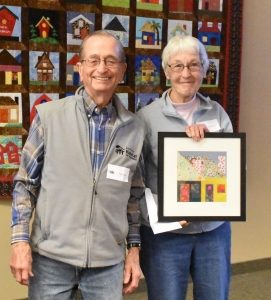
• 5 years – Beth Greck and Buddy Tallant
• 10 years – Ross Akin, Alan Cutter, Joyce Davis, Lou Farquhar, Neil O’Sullivan, Ken Roth, Sharon Waugh, Jim Worley
• 15 years – Ray Ducharme, Bob Laveck
• 20 years – Ken and Carol Deal (pictured, R)
We celebrated staff milestones, too. John Meadows has been a Construction Supervisor for 10 years and Kenny Busch just reached the 15 year mark!
Director of Construction Services Paul Reeves noted that 2016 was a year of change, with multiple staffing changes and four different building sites. None the less, our staff and volunteers rose to the occasion and served the largest number of families to date. 44 Home Repair clients and 14 new homeowners in Buncombe County now have decent and affordable housing.
Looking forward, we’ll be moving to Arden in the early summer to begin a 21-house subdivision, and we’ll be building a Habitat house in McDowell County as part of the SECU Challenge to build or renovate 100 houses in 100 NC counties. Also, we will solidify plans to introduce multi-family housing on a 16-acre parcel in West Asheville that the City of Asheville is helping us secure.
Home Repair Supervisor Joel Johnson thanked his core volunteers, Lonnie Lief and Garland Walker, who have been volunteering consistently for 3 years. Home Repair is unlike new construction in that the scope of work varies from project to project and the jobsite often changes daily. It’s difficult to plan a volunteer calendar in advance, so we appreciate Lonnie and Garland’s flexibility and commitment to the growing Home Repair program.
We were also pleased to be joined by Jeff Staudinger (pictured below), the Community Development D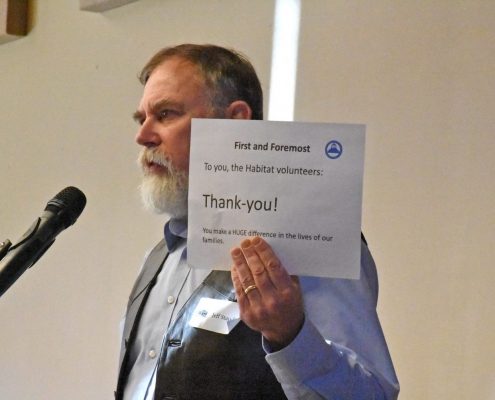 irector for the City of Asheville, who was able to put Habitat’s contributions into the larger affordable housing context. He expressed the City’s enthusiasm for Habitat’s upcoming higher density neighborhood in West Asheville (currently referred to as Cedar Hill). Staudinger also referenced statistics from the Bowen Report and reiterate the City’s commitment to creating new public/private partnerships, and continuing to work to remove barriers, increase density, and strengthen the relationship between housing and transportation. “Shelter is the foundation for everything else,” he noted. “And as Habitat volunteers, you are working directly on the affordable housing crisis.”
In closing remarks, Executive Director Andy Barnett reminded the audience, “You are volunteering regularly to build the kind of community you want to live in…you are the hearts, hands and voices of affordable housing. You embody our mission.”
Habitat volunteers build and repair houses – and they build community. They help families build strength, stability and self-reliance. If you would like to be part of the affordable housing solution, click here to learn about Habitat volunteer opportunities.
To see event photos, please click here.