
Spring Break Builders
By Sammie Smith, Hands and Feet of Asheville Intern
Every March, our construction site fills up with excited college students participating in their Alternative Spring Break. Collegiate Challenge – or as we affectionately call it, March Madness – brings students from schools all over the country to Asheville for a week of volunteering. This year, we hosted students from Southern Illinois University Edwardsville, Lesley University (Massachusetts) and Ramapo College (New Jersey). One of the highlights of these service trips is the Wednesday night dinner with a future Habitat homeowner.
The most recent dinner included volunteers from both Leslie and Ramapo. In addition to enjoying fellowship and a delicious meal (thanks to a Thrivent grant), the students reflected on the work they’ve done at the construction site and how it has impacted them. Kit, from Lesley University spoke about how amazing the construction supervisors are and how “they take the time to carefully teach us how to complete the tasks on the jobsite”. Ramapo student Carlie noted, “It was rewarding to see the progression throughout the day from just dirt and rocks to a clean, insulated crawl space.” She went on to talk about how important stable housing is for kids to excel in school. Another Ramapo student reflected on the comradery among future homeowners stating, “I’ve been amazed by the sense of community…Homeowners working on each other’s houses even before they move in. Every step is awesome!” After a few days of working on the construction site and in the ReStore, Shannon, from Lesley University shared “the more I learn about Habitat, the more I fall in love with the organization!”
Jeff Paul, Habitat’s Homeowner Counselor, explained to the students the comprehensive process that Habitat homeowners go through: from initial application, through sweat equity hours and homeownership education classes, to the final walk-through just after closing. He talked about the importance of a safe, decent, and stable place to call home and then introduced future homeowners Tim Bromely and his wife Jenny Giannetto and their three children. Tim talked about how excited their oldest son is to soon have his own room and what it will mean for their family to finally have stability. (They have moved 7 times in the last 9 years.) And he expressed deep gratitude to the students for their service with Habitat.
Thank you to all the Collegiate Challenge volunteers who dedicated their spring break to volunteering with Asheville Habitat! We are consistently impressed by these young adults who make service a priority in their lives and get involved in a hands on way, with causes that matter to them. When asked why she came to Asheville Habitat for spring break, Cheryl, a student from Ramapo College said, “Affordable housing is such a huge issue in the United States. If I can contribute in a small way, it’s worth it!”
To see photos, click these links: Ramapo, Lesley, and Southern Illinois.

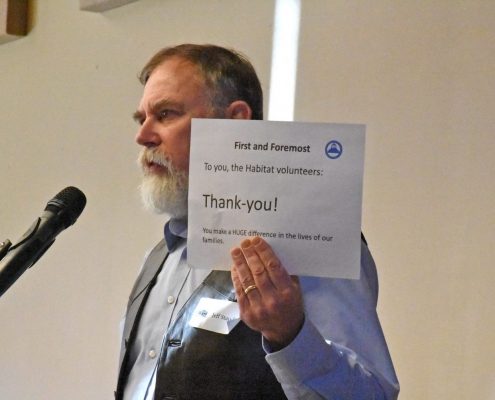 irector for the City of Asheville, who was able to put Habitat’s contributions into the larger affordable housing context. He expressed the City’s enthusiasm for Habitat’s upcoming higher density neighborhood in West Asheville (currently referred to as Cedar Hill). Staudinger also referenced statistics from the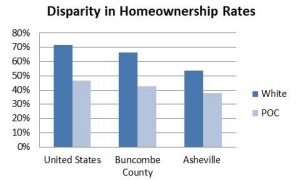
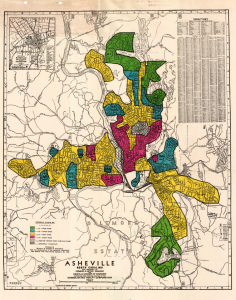
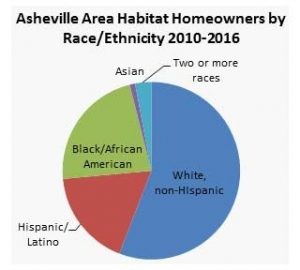 Habitat creates a way for households facing economic barriers to achieve homeownership and begin to close the wealth gap, but we can’t do it alone. To achieve equity in rates of homeownership nearly 3,000 additional households of color in Buncombe County will need the opportunity to become homeowners. To achieve this scale, we will need many more lenders to adopt policies that help households of color overcome historical barriers to mortgage loans. We need to grow housing and financial counseling opportunities to help aspiring homebuyers become “mortgage ready”. We need more affordable rental options and tenant advocacy so that renters have the stability needed to save and prepare for future ownership. Finally, we need home repair and foreclosure prevention assistance to help existing homeowners to remain at home. In short, it will take everyone committing to give our time, our financial support, and our voices to advance the dream of equality of opportunity for all our neighbors regardless of race.