Tag Archive for: Affordable Housing

New House, New Beginnings

,

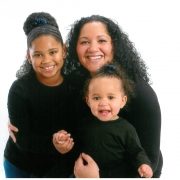
The nine year old girl, center of her mother’s world, is too young to fully comprehend what her new Habitat home means to her mom and to their family. But she sure is excited to decorate her room and play with friends in her new neighborhood!

Elizabeth, the young girl’s mom, credits her daughter for inspiring her to better her future, and her father for encouraging her in the right direction. With motivation and support, she enrolled at AB-Tech, become a CNA, and secured a good job with a local alcohol and drug treatment center. Her next goal was straightening out her credit and becoming a homeowner. Mission accomplished, as she just signed her mortgage documents and proudly accepted the keys to her new Habitat home!

“One day she will realize how strong she made her momma,” said Elizabeth while proudly showing photos of her daughter and son, and waiting to sign her closing documents.

“I’ve had to make some very difficult decisions in the last six or seven years. If I stayed with her dad, I was staying in an abusive situation. But if I left that would mean my daughter would grow up without a father.”

Ultimately, Elizabeth chose the latter and is overwhelmed by everything she has accomplished for herself and her family — by herself. She was overcome with emotion as she looked at the key in her hand and thought back to a time of hopelessness. Proud of her perseverance and excited about what the future holds Elizabeth headed to her new home where her friends and her father were waiting to help her unload a U-Haul truck and unpack a fresh start.

If you’d like to learn more about Habitat’s affordable homeownership program, click here.
Spring Break Builders

, , ,

By Sammie Smith, Hands and Feet of Asheville Intern

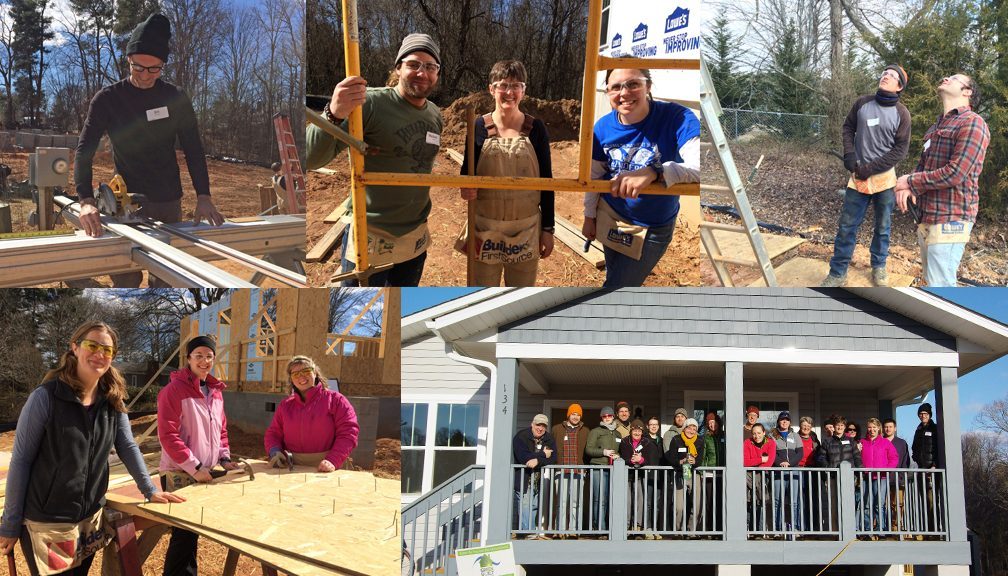
Every March, our construction site fills up with excited college students participating in their Alternative Spring Break. Collegiate Challenge – or as we affectionately call it, March Madness – brings students from schools all over the country to Asheville for a week of volunteering. This year, we hosted students from Southern Illinois University Edwardsville, Lesley University (Massachusetts) and Ramapo College (New Jersey). One of the highlights of these service trips is the Wednesday night dinner with a future Habitat homeowner.

The most recent dinner included volunteers from both Leslie and Ramapo. In addition to enjoying fellowship and a delicious meal (thanks to a Thrivent grant), the students reflected on the work they’ve done at the construction site and how it has impacted them. Kit, from Lesley University spoke about how amazing the construction supervisors are and how “they take the time to carefully teach us how to complete the tasks on the jobsite”. Ramapo student Carlie noted, “It was rewarding to see the progression throughout the day from just dirt and rocks to a clean, insulated crawl space.” She went on to talk about how important stable housing is for kids to excel in school. Another Ramapo student reflected on the comradery among future homeowners stating, “I’ve been amazed by the sense of community…Homeowners working on each other’s houses even before they move in. Every step is awesome!” After a few days of working on the construction site and in the ReStore, Shannon, from Lesley University shared “the more I learn about Habitat, the more I fall in love with the organization!”

Jeff Paul, Habitat’s Homeowner Counselor, explained to the students the comprehensive process that Habitat homeowners go through: from initial application, through sweat equity hours and homeownership education classes, to the final walk-through just after closing. He talked about the importance of a safe, decent, and stable place to call home and then introduced future homeowners Tim Bromely and his wife Jenny Giannetto and their three children. Tim talked about how excited their oldest son is to soon have his own room and what it will mean for their family to finally have stability. (They have moved 7 times in the last 9 years.) And he expressed deep gratitude to the students for their service with Habitat.

Thank you to all the Collegiate Challenge volunteers who dedicated their spring break to volunteering with Asheville Habitat! We are consistently impressed by these young adults who make service a priority in their lives and get involved in a hands on way, with causes that matter to them. When asked why she came to Asheville Habitat for spring break, Cheryl, a student from Ramapo College said, “Affordable housing is such a huge issue in the United States. If I can contribute in a small way, it’s worth it!”

To see photos, click these links: Ramapo, Lesley, and Southern Illinois.


Building More than Houses

, , , , ,

Each February, we celebrate our Construction Services volunteers with an Appreciation Breakfast. This year nearly 80 volunteers and staff members gathered as we celebrated collective accomplishments, honored longevity, recognized significant hourly contributions, and talked about the future.

Here are a few highlights shared during the event:
• More than 50% of the total volunteer hours contributed to Asheville Habitat’s construction program in 2016, were contributed by 80 construction “core” volunteers! These folks volunteer on our jobsite at least one day each week.
• Collectively, construction cores provided 17,570 hours of volunteer service!
• 28 cores each contributed more than 250 hours of service last year. Each received a golden hammer pin.
• The highest hours earner was CJ Obara, with 641 hours!

Longevity awards recognize years of volunteer service:
• 5 years – Beth Greck and Buddy Tallant
• 10 years – Ross Akin, Alan Cutter, Joyce Davis, Lou Farquhar, Neil O’Sullivan, Ken Roth, Sharon Waugh, Jim Worley
• 15 years – Ray Ducharme, Bob Laveck
• 20 years – Ken and Carol Deal (pictured, R)

We celebrated staff milestones, too. John Meadows has been a Construction Supervisor for 10 years and Kenny Busch just reached the 15 year mark!

Director of Construction Services Paul Reeves noted that 2016 was a year of change, with multiple staffing changes and four different building sites. None the less, our staff and volunteers rose to the occasion and served the largest number of families to date. 44 Home Repair clients and 14 new homeowners in Buncombe County now have decent and affordable housing.

Looking forward, we’ll be moving to Arden in the early summer to begin a 21-house subdivision, and we’ll be building a Habitat house in McDowell County as part of the SECU Challenge to build or renovate 100 houses in 100 NC counties. Also, we will solidify plans to introduce multi-family housing on a 16-acre parcel in West Asheville that the City of Asheville is helping us secure.

Home Repair Supervisor Joel Johnson thanked his core volunteers, Lonnie Lief and Garland Walker, who have been volunteering consistently for 3 years. Home Repair is unlike new construction in that the scope of work varies from project to project and the jobsite often changes daily. It’s difficult to plan a volunteer calendar in advance, so we appreciate Lonnie and Garland’s flexibility and commitment to the growing Home Repair program.

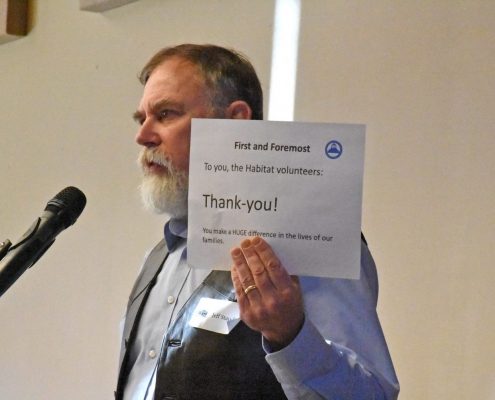
We were also pleased to be joined by Jeff Staudinger (pictured below), the Community Development Director for the City of Asheville, who was able to put Habitat’s contributions into the larger affordable housing context. He expressed the City’s enthusiasm for Habitat’s upcoming higher density neighborhood in West Asheville (currently referred to as Cedar Hill). Staudinger also referenced statistics from the Bowen Report and reiterate the City’s commitment to creating new public/private partnerships, and continuing to work to remove barriers, increase density, and strengthen the relationship between housing and transportation. “Shelter is the foundation for everything else,” he noted. “And as Habitat volunteers, you are working directly on the affordable housing crisis.”
In closing remarks, Executive Director Andy Barnett reminded the audience, “You are volunteering regularly to build the kind of community you want to live in…you are the hearts, hands and voices of affordable housing. You embody our mission.”

Habitat volunteers build and repair houses – and they build community. They help families build strength, stability and self-reliance. If you would like to be part of the affordable housing solution, click here to learn about Habitat volunteer opportunities.

To see event photos, please click here.


Where Habitat Fits in the Movement for Racial Equity

, ,

By Andy Barnett, Executive Director

Earlier this week, we observed the Martin Luther King Jr. Holiday. The holiday provides an opportunity to reflect on the legacy of Dr. King and to recommit to a vision of equity for our neighbors who face barriers due to intentionally discriminatory policies and structures of power. Dr. King saw a great deal of progress toward racial equity in his lifetime and we have seen more in the years since his death. But much remains to be done to realize the dream of a nation where everyone has the chance to live up to their potential regardless of where they start from and the obstacles in their path. Continuing this work is our challenge today.

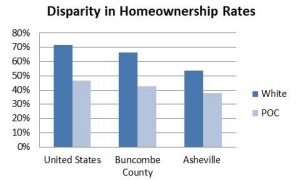
Homeownership Disparity; Source: U.S. Census Bureau, 2011-2015 American Community Survey 5-Year Estimates

One of the places where we haven’t seen progress toward racial equity, where, in fact we see a widening gap between whites and people of color is in household wealth. In 1963, the disparity in median family wealth was about $40,000; white households now have a median net worth $123,000 higher than African American families according to a report by the Urban Institute. This means that white families are much more able to weather financial hardships, take advantage of education and career opportunities, and participate in a virtuous cycle where the wealth attainment of one generation becomes the platform for the next. Families of color are much less likely to see these benefits.

A number of factors contribute to the widening gap in wealth including income, employment, family wealth, and education attainment. But, the largest single factor is homeownership—accounting for more than 25% of the disparity according to a Brandeis study.  White households are more likely to own homes. In Buncombe County, 72% of white households own their home while fewer than half of households of color are homeowners. This level of disparity in homeownership is consistent with national homeownership gap. Not only are households of color less likely to own homes, they also build equity more slowly (and lose it more quickly) than white households.

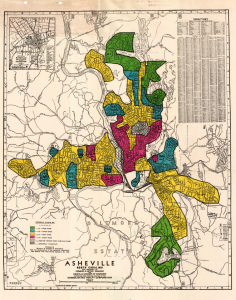
Home Ownership Loan Corporation “redlining” map of Asheville

This disparity is the result of intentional real estate and mortgage lending practices.  Beginning in the 1930’s, federal underwriting policy established lending risk based on geography.  Communities of color were identified as having a greater risk of default. As a result, these “redlined” areas were largely excluded from the post-war housing boom in housing development finance. Across the country new developments legally excluded Black and Latino buyers through restrictive covenants, and at the same time, neighborhoods of color declined due to lack of capital investment.

This pattern of lending created, in effect, two housing markets. One that rapidly appreciated in value and was restricted to whites, and another for people of color where values and conditions stagnated or declined. Overtime the deteriorating conditions in these disinvested neighborhoods “proved” that race-based lending practices were justified and these neighbors were blamed for the poor conditions rather than recognized as victims of discriminatory practices. Even after housing discrimination based on race was outlawed, “blight” and a “blame the victim” culture made it easy to justify redevelopment and displacement. Unfortunately, two generations of households have missed out on wealth building through a period of historic home value appreciation.

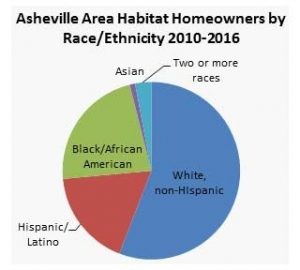
This is where Habitat’s work enters the story. We are a builder and a bank. Our programs simultaneously address geographic disinvestment and create a path to successful homeownership. Habitat develops housing in neighborhoods that other developers might reject, but where opportunities exist for a good quality of life for homeowners. Depending on the market, Habitat’s investment can boost a stagnating market or build long term economic integration in a “hot” market. By financing and assisting repairs for existing homeowners, Habitat preserves the housing stock and adds value to existing neighborhoods. Habitat lends to first time buyers and finances repairs for existing owners that other lenders have determined are too “risky”. Through careful underwriting, extensive education, a focus on partnership with the borrower, and a commitment to affordable mortgage terms, Habitat successfully extends homeownerships to households with incomes well below what it would take to qualify for a conventional mortgage. Since 2010, 45% of those new homeowners were households of color.

Habitat creates a way for households facing economic barriers to achieve homeownership and begin to close the wealth gap, but we can’t do it alone. To achieve equity in rates of homeownership nearly 3,000 additional households of color in Buncombe County will need the opportunity to become homeowners. To achieve this scale, we will need many more lenders to adopt policies that help households of color overcome historical barriers to mortgage loans. We need to grow housing and financial counseling opportunities to help aspiring homebuyers become “mortgage ready”. We need more affordable rental options and tenant advocacy so that renters have the stability needed to save and prepare for future ownership. Finally, we need home repair and foreclosure prevention assistance to help existing homeowners to remain at home. In short, it will take everyone committing to give our time, our financial support, and our voices to advance the dream of equality of opportunity for all our neighbors regardless of race.
P.S. – On MLK Day, a group of Habitat staff members and volunteers watched this 30 minute film together to gain a better understanding of the complex roots of today’s racial inequity in housing. I encourage you to make the time to watch it.


Sign Up Now for Singles Build!

, , ,

This Valentine’s Day weekend join 30 other young, single professionals for a meaningful day of making connections and making a difference.

Your $20 registration fee will cover the cost of building materials. Lunch is generously provided by Moe’s Original Bar B Que! Participants (age 21+) will also take part in fun meet & mingle activities and will be invited to a Singles Build happy hour at Village Wayside Bar and Grille at the end of the day! (Thank you to Village Wayside for contributing 50% off coupons to our participants!)
No experience is necessary, just come prepared to work hard on our construction site and have a great time.

♥ Saturday, February 11, 2017

♥ 8:15 a.m. to 3:30 p.m. at the McKinley jobsite off Taft Avenue in Shiloh neighborhood.

Step 1 – Sign Up: Create an account and register using our online system.
Step 2 – Donate: Your $20 donation will complete your registration; please click here to donate online. Please choose “Singles Build” as your Area of Support.
Step 3 – Build! You will receive an email confirmation upon registration and a reminder before your build day on February 11th.

For more information, please contact Sammie Smith, Volunteer Services Intern.


Fellow North Carolinians need our help!

, , , ,

Fayetteville Area Habitat for Humanity and its community of homeowners have suffered a terrible fate in the wake of Hurricane Matthew. Of Fayetteville Habitat’s 154 homes, 93 Habitat houses have been flooded extensively, and 66 may be complete losses. “There are powerful and heartbreaking stories of families swimming out of their homes to reach rescuers, lost possessions, and the loss of beloved family pets. Habitat homeowners work hard to pay their mortgages but it will be difficult, in some cases impossible, for most of them to pay both a mortgage and also rent a place to live,” stated a representative from Fayetteville Habitat. Please keep these families in your hearts and prayers and read below to see how you can help.

Make a donation to Hurricane Relief/Fayetteville Habitat
DonateJoin us to help Habitat neighbors in need! Asheville Area Habitat is donating to the hurricane relief efforts of Fayetteville Habitat for Humanity in honor of our Board of Directors. We invite you to do the same. Donate online and select Hurricane Relief/Fayetteville Habitat in Area of Support. Thank you!

“Round Up” at the ReStore registers
From November 1st through December 31st donations collected through the register Round Up program will be donated to Fayetteville Habitat for Humanity for hurricane relief efforts. For example, if your purchase totals $9.40, please round up to $10.00. Small amounts can really add up to make a big difference!

Go to Fayetteville to volunteer
Please clear your calendar and join one of our service trips, if you’re able. The work will be basic demo/muck/gut. No experience necessary. Transportation and lodging will be provided. Some meals may be provided but each volunteer should be ready to pay the majority of their food expenses.
Sunday, November 13 (noon departure) – Friday, November 18 (dinnertime return) 4 ½ work days
OR
Thursday, December 1 (noon departure) – Sunday, December 4 (dinnertime return) 2 ½ work days.
Please email Stephanie asap if you’d like to participate.

Thank you for helping our fellow North Carolinians in need!

Hudson Hills is complete!

, , , , ,

“I come home each day through the street filled with smiling children on bikes, playing on the sidewalks and shooting baskets through hoops. I come home to people visiting and sharing and laughing and smiling on their porches or walking their babies or puppy dogs. I come home to a sanctuary. A place filled with so much love. Hudson Hills Soulshine.”
~ Rhonda, Habitat homeowner

Successful affordable housing initiatives require the partnership of many constituent groups – public, private and municipalities. Last week, we celebrated the completion of our most recent neighborhood, Hudson Hills. It was made possible with the support of the City of Asheville, Buncombe County, North Carolina Housing Finance Agency, the W&S Foundation (through Warren Haynes Presents: The Christmas Jam), and many local businesses, individuals, faith partners, and foundations. Funding was also provided by Habitat homeowner mortgage payments and ReStore proceeds. And in addition to funding, thousands of community volunteers – alongside future homeowners – built these homes.

House sponsor representatives presented ceremonial keys to the last six homes in the neighborhood, among a sea of children and large group of well-wishers. Executive Director Andy Barnett pointed out that three of the program participants have dedicated their careers to affordable housing: Bill Dowse from NCHFA (North Carolina Housing Finance Agency); Lew Kraus and Joan Cooper who recently retired from Asheville Area Habitat; and Jeff Staudinger, the City of Asheville’s Assistant Director of Community and Economic Development. Leadership from affordable housing advocates like these three, coupled with diverse funding partnerships, dedicated volunteers,  and future homeowner participation has proven time and again to be a recipe for a successful Habitat community.

With the strong foundation provided by decent and affordable homes, 24 more local families now have the strength, stability and self-reliance they need to build a better future for themselves. With a decent place to live and an affordable mortgage, these homeowners can save more, invest in the future, pursue opportunities, and have more stability. THANK YOU to everyone who helped us build Hudson Hills, a beautiful community of decent, affordable, energy-efficient houses, that are being turned into homes.

To see photos from the October 14th dedication event, please click here.

To see a short video produced by Buncombe County TV, click here.

Safe home in a tight-knit community is a dream come-true for the Trantham-Roper family

, ,

By Kristen Keefer

This past June, Vicki Trantham and her two sons Geoffrey (Roper), 25, and Rowan, 10, moved into their Hudson Hills home, made possible by proceeds from Warren Haynes Presents: The Christmas Jam. The family harnesses a special dynamic, with oldest son Geoffrey (who is also on the deed) helping his mom Vicki raise her youngest son Rowan. The path that led this family to their forever home was filled with hard work and dedication. And today, the family is deeply rooted in the Habitat community.

Though their plates were already full when they began the journey to become homeowners, Vicki and Geoffrey enthusiastically embraced putting in sweat equity. Geoffrey shared, “It never felt like extra work. Volunteering on the weekends never felt overwhelming after the full 40 hour work week.” For him, being on the construction site was a valuable time to work with his neighbors, develop carpentry skills, and share the company of great people.

Geoffrey viewed sweat equity as an opportunity not an obligation. Geoffrey recalled, “The overall experience has been full of hope and very eye-opening.” He shared memories from his first meeting with Habitat homeowner selection committee members. Saying, “We felt so welcomed into the Habitat family. The committee members genuinely wanted to work with us.”

Currently Geoffrey is quite busy, working as a full-time pastry chef at Filo and actively playing guitar in local band The Spiral. And, though he has already completed his sweat equity, in the future he plans to return to the construction site to continue to volunteer his time to Habitat.

Geoffrey also lends his time to his younger brother Rowan. Vicki, who is a breast cancer survivor, expressed how helpful this has been to her, allowing her the opportunity to engage in activities away from home, including continuing her service with Habitat. Vicki is now a “core volunteer”, volunteering her time weekly in the administrative office, as well as at the ReStore. Being able to continue her service has filled her with happiness. She shared, “It’s wonderful to be able to give back and help other families. It’s what we wanted to do!”

The family is incredibly grateful for the opportunities they’ve been able to pursue since joining the Habitat community. Vicki shared that prior to purchasing a Habitat home they had been staying in a rural setting, in dangerous and nearly unlivable conditions. Relocating to Hudson Hills has not only given them a safe place to call home, but integrated them into a tight-knit community. Geoffrey explained, “We’ve never lived in a neighborhood before. It’s cool to see Rowan have so many friends in the neighborhood. I’m secondhand-excited for him!”

Vicki, Geoffrey, and Rowan are an inspirational family. When you meet them, you instantly feel at ease. Together they embrace a unique dynamic, sticking together through thick and thin. Their commitment to each other and the hard work they’ve put in to reach their dream of homeownership represents everything Habitat strives to support in building homes and building communities.

City Bond Referendums on Your Ballot November 8th

,

Election Day is Tuesday, November 8, and while we’ve all been hearing about the Presidential race for months, there are many other important issues in this year’s election. We’ll be electing a Governor and a Senator in our state, for example. This year, the City of Asheville has three bond referendums on the ballot.

A general obligation bond is a way for cities to borrow money to pay for large construction projects. Because bonds aren’t part of the annual budget of the City, they get voted on in a referendum. Many cities regularly hold bond referendums, but Asheville hasn’t done so in over 20 years. These bonds will be at the very bottom of the ballot.

The three bonds are for: Parks and Recreation, Affordable Housing, and Streets, Sidewalks and Bike Lanes. You can read more about each of them on the City’s website, which includes a break-down of how the money will be used if the bonds are approved along with interactive maps so you can see the priority projects around the City.

Several large groups in town support the bonds, including the United Way and the Chamber of Commerce, and they created a website, Facebook page, and YouTube testimonials, which you can access here.

Early voting in North Carolina begins on October 20 and continues through November 5 at twenty sites around the County, which are open most days during this period from 10 a.m. – 6 p.m. If you haven’t registered to vote at your current address you can do same-day registration during early voting. During early voting you can go to any of the open voting sites, but if you choose to vote on November 8, Election Day, you must vote at your own precinct site.

Help us welcome two more families HOME on April 15th

, ,

Thanks to an anonymous donation through the Community Foundation of WNC, Asheville Area Habitat launched it first-ever Business Bungalow House last summer. All donations to the house by local businesses, were matched (up to $25,000) by that caring donor. The response from the local business community was so strong that we were able to build not 1, but 2 Business Bungalow houses!

Booth family in front of house (10) Armstrong familyWe are grateful for all the donors who stepped up to help address the affordable housing crisis in our region by helping us build two more affordable, energy-efficient houses for two local families in need of safe, decent and affordable housing. Please join us for the dedication of these homes on Friday, April 15th at 3:30pm in our Hudson Hills neighborhood to welcome the Booth and Armstrong families HOME. Call Betsy at 828.210.9363 to RSVP. Space is limited!

Tag Archive for: Affordable Housing

Nothing Found

Sorry, no posts matched your criteria